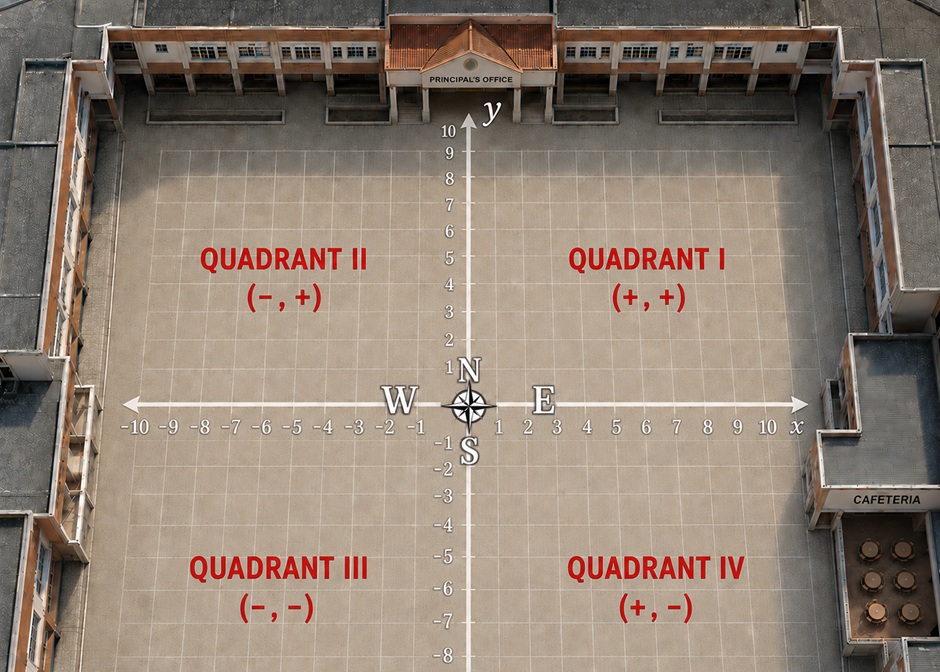
Lal Bagh High School served the Lal Bagh slum area. Every year, Grade 8 students from three local middle schools visited it to see the school they would attend in the future. Some Grade 10 volunteers would take them around, showing them the cafeteria and the different classrooms. At the end of the visit, everyone would gather in the school compound, where the principal would welcome the visitors before they returned home.
The school received only a small amount of money from the government, and finances were always tight. Every year, the principal applied for additional funds, but the applications were rejected.
This year there was a new district education officer. After reviewing the principal’s request, she wrote that she would visit the school before making a decision. Hoping to make a good impression, the principal invited her to come on the same day that the Grade 8 students were visiting.
The principal called a staff meeting and asked for ideas. The teachers remained silent. Finally, one of them suggested that Rania Ali organize something special. Under pressure from her colleagues, she reluctantly agreed.
Rania Ali was about to begin teaching coordinate geometry to her Grade 10 students. Suddenly, an idea came to her. Perhaps she could use the visit to get her students interested in mathematics and, at the same time, impress the district education officer.
She called Taheen, whom she had once caught drawing graffiti on the school walls. Although she had punished him at the time, she knew that he was talented at drawing parallel lines. She also called Rajab, one of the sharpest students in the class.
After listening to her plan, Rajab asked, “Do you want us to do a giant graph graffiti?”
Rania Ali smiled.
“Exactly.”
Rania Ali arranged for the school to buy the supplies, and the grade 10 students did the rest.
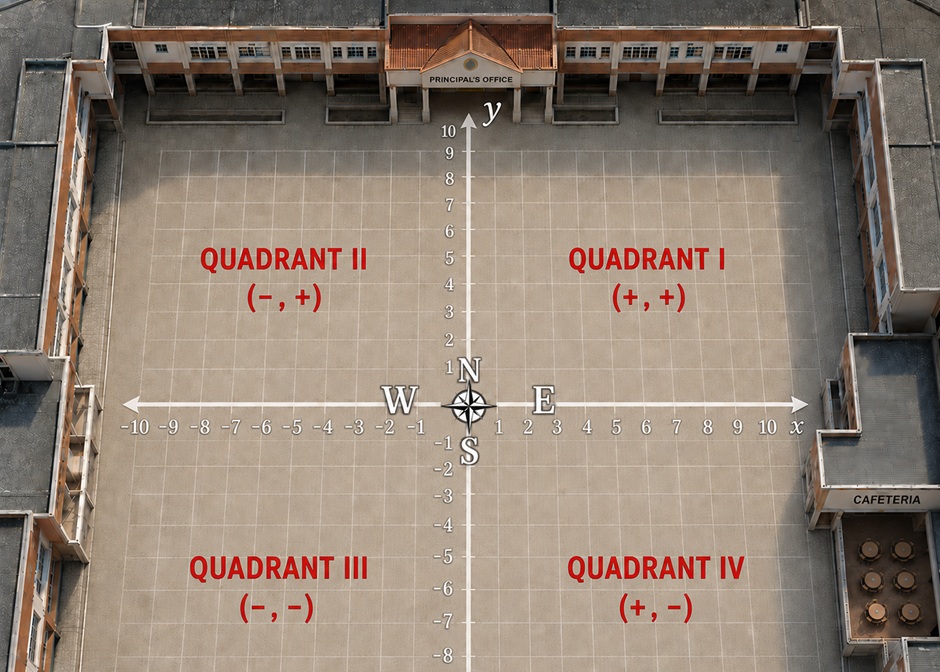
The visiting grade 8 students started arriving at 9 a.m. They were given the usual tour and then brought to the school compound. There were 70 students in all. The district officer was requested to sit in the principal’s office so she could watch the event.
At 11 a.m., Rania Ali stood near the cafeteria with a microphone in her hand.
“I am Rania Ali. I am a teacher here, and today I am going to show you that Lal Bagh is a fun school. We will have a competition, and seven winners will get prizes. No one can win more than one prize.
“This competition is not for kabaddi or athletics. It is for coordinate identification. The school compound has been turned into a giant graph paper. The point where I am standing is the origin: zero.
“The x-axis runs from here toward the main office and also in the opposite direction. Numbers toward the main office are positive, from 1 to 10. Numbers in the opposite direction are negative, from -1 to -10.
“The y-axis runs across the compound from west to east. East has positive numbers, and west has negative numbers. I will give you five minutes to look at the giant graph. Then I will call out two numbers, like (-10, 10). The first number is the x-coordinate, and the second number is the y-coordinate. The student who stands at the correct spot first will win a prize. We will do this seven times.”
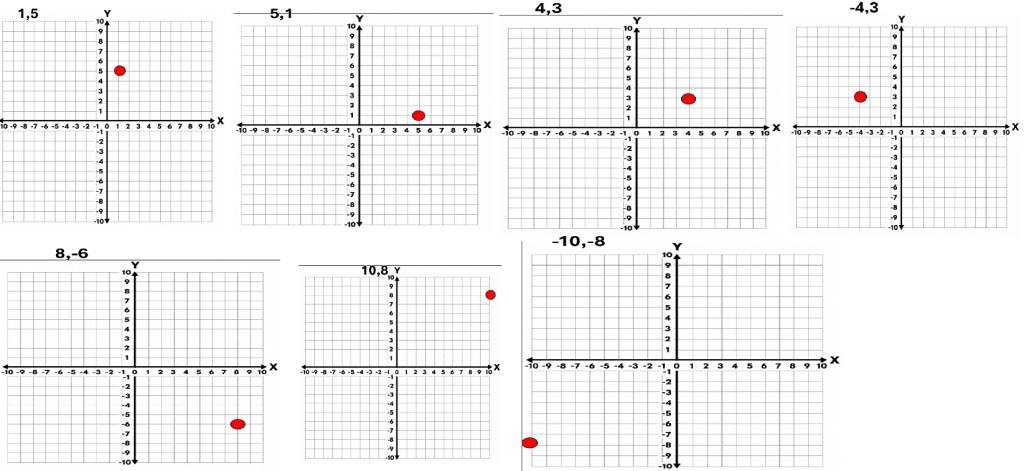
Rania Ali announced the coordinate (1, 5). There was some chaos as students rushed across the giant graph. Soon one student reached the correct spot. Arisha checked the location and marked the coordinate with a red dot on a graph paper. Manisha recorded the winner’s name. This process was repeated seven times until seven different coordinates had been identified (Fig. 2). Afterwards, each student was given a picture of the Giant Graph and a picture showing all seven coordinates. They proudly took the pictures home.
Fig. 2
The officer was asked to do the honor of awarding prizes to the seven students. She gave a speech indicating her pleasure on the innovative way of educating the students.
Three weeks later, the principal received a letter indicating how impressed the officer was on the innovative method of teaching at Lal Bagh school. The letter contained a cheque for Rs. 100,000 and an invitation to Rania Ali to come and explain her methods to the education department.
Challenge
Determine the distance between point A with coordinates (2, 8) and point B with coordinates (8, -6).
Solution
On graph paper, mark points A(2, 8) and B(8, -6) as shown in Fig. 3. Draw a vertical line down from A and a horizontal line left from B. Let the crossing point be C.
Fig, 3
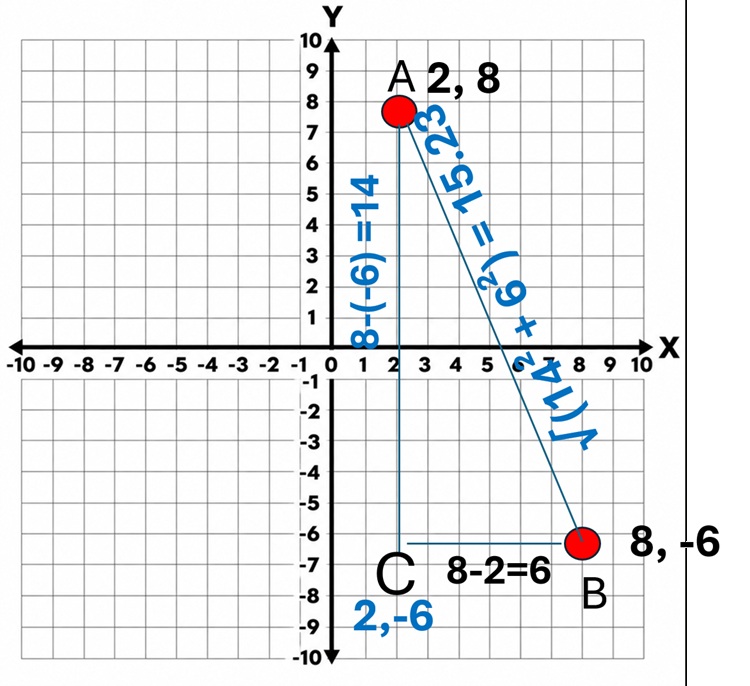
Point C has the same x-coordinate as A and the same y-coordinate as B. Therefore, C is (2, -6).
The distance from B(8, -6) to C(2, -6) is:
8 – 2 = 6
The distance from A(2, 8) to C(2, -6) is:
8 – (-6) = 14
Now triangle ABC is a right-angled triangle, with AB as the hypotenuse. Using Pythagoras’ Theorem:
AB² = AC² + BC²
AB = √(14² + 6²)
AB = √(196 + 36)
AB = √232
AB = 15.23
Therefore, the distance between A and B is 15.23 units.

